Beyond the Rust Belt: How Regions Grow
Last year, Edward Lawlor, Dean Emeritus at the Brown School at Washington University and I completed a study on St. Louis commissioned and funded by the James S. McDonnell Foundation. Our conclusion was that inclusive regional growth and economic prosperity are within St. Louis’ grasp thanks in good part to three positive regional trends: First, is the awakening to the link between the region’s overall success and that of its Black population; second is support and investment in new industries and sectors, particularly ag tech and biotech; and third is the affordability, quality of life and urban amenities in the region, particularly in the central corridor of the city.
For that optimistic outlook to be achieved, however, the region must act as one. Without greater coordination, the St. Louis region will not be able to match the success experienced in four peer communities examined in study. Our great challenge is the lack of strong mechanisms and traditions of regional cooperation.
The study titled “Inclusive Growth in St. Louis: Lessons from Successful Regions”, examined in detail the path toward inclusive prosperity success by examining other older Heartland cities that have successfully faced economic headwinds.
“Inclusive Growth in St. Louis: Lessons from Successful Regions”, examined in detail the path toward inclusive prosperity success by examining other older Heartland cities that have successfully faced economic headwinds.
The study was preceded by work we have done in the past five years analyzing the relative success of the 50 largest U.S. metropolitan regions on three criteria: population growth, per capita income and income growth, and Black-White income gaps. In this study we focused on outlier regions that outperformed peers on these metrics and that had no particular geographic advantage (on the coast or other recreational advantages such as mountains for Denver). Ultimately, the analysis concentrated on four comparative success stories: Atlanta, Kansas City, Nashville and Pittsburgh. In each city, we reviewed data and literature and interviewed regional leaders.
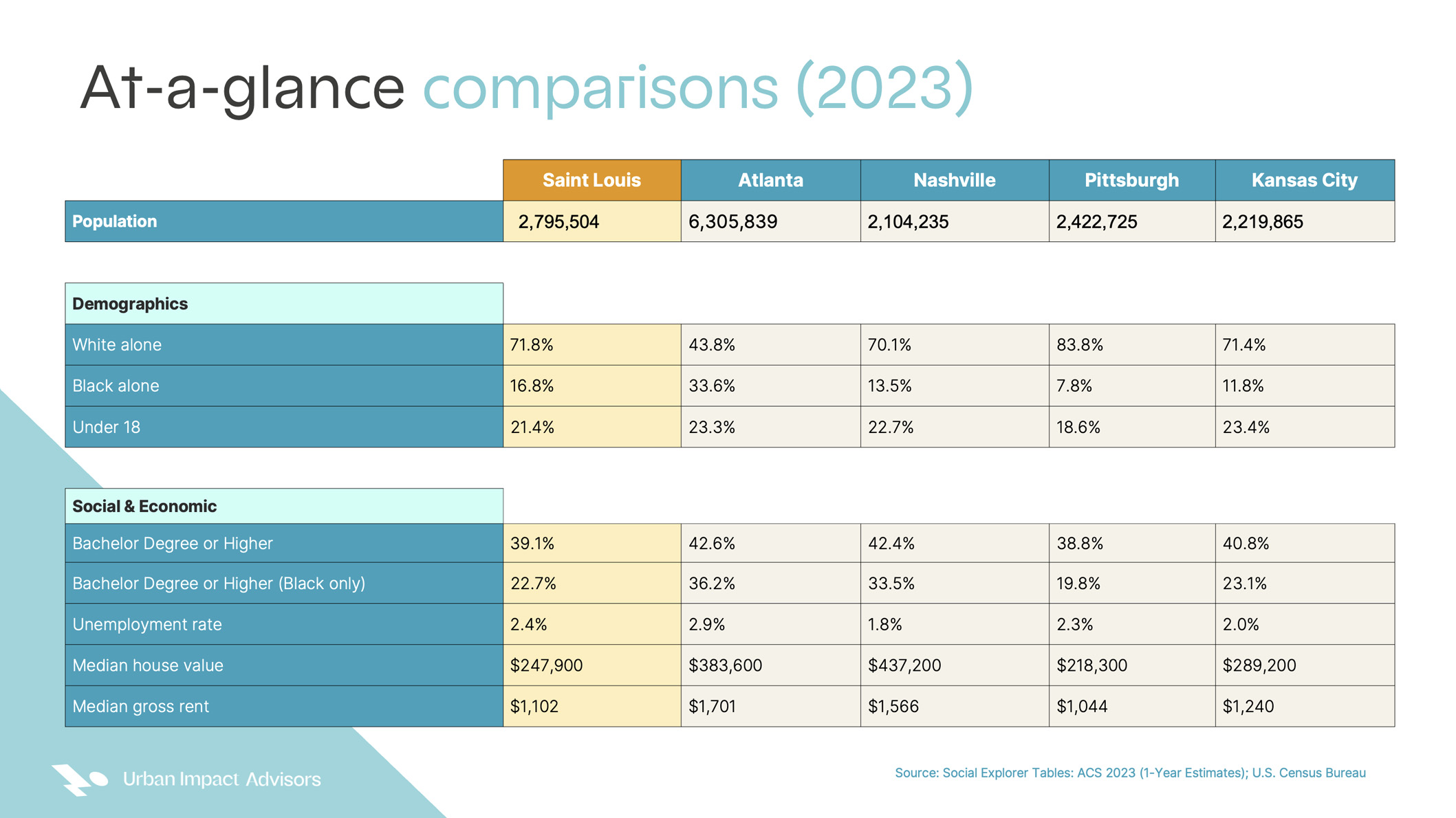
Several keys to those regions’ success emerged — some not necessarily surprising —though each represents a substantial challenge for St. Louis.
For example, the analysis highlighted the influence of strong economic development organizations such as Nashville’s, where regional marketers “created a vibe as a place to become what you want to become” — with a moderate cost of living.The study also surfaced the critical importance of vibrant downtowns, with all four comparison cities boasting downtowns much stronger than St Louis.
The report notes the critical role universities played in all four communities —including Pittsburgh, where leaders at Carnegie Mellon University and the University of Pittsburgh sprang into action and created new industries in bio-tech, computing and robotics when the city’s steel industry collapsed.
The importance of strong economic development, downtowns and universities was not surprising to us. What was surprising was the role of regional confidence in a bright future, the transformative impact of key individuals, and the necessity of defining a clear competitive advantage.
- An Optimistic Mindset: Leaders in successful regions share a palpable, collective belief that better days are ahead. We interviewed a woman originally from Syracuse who spoke poignantly about moving to Atlanta for law school and “being amazed at the confidence and sense that progress could be achieved.” She stayed after graduation and became a key Atlanta leader.
- Transformative Leadership: Exceptional individuals drive change. Atlanta philanthropist and longtime Coca-Cola President Robert Woodruff’s enduring influence was huge, along with mayors William Hartsfield and Maynard Jackson, who championed Atlanta as an aviation hub. Jackson was also notable for ensuring that African American businesses were major contributors to building the airport, helping create one of the strongest Black business communities in the United States.
- A Competitive Advantage: Kansas City’s upbeat regional sense of a welcoming and affordable place to raise a family is remarkably consistently mentioned by people in the region. This message, and its underlying reality, has underpinned Kansas City’s success including are vitalized downtown, where its population has surged 132% since 2000.
St. Louis has key assets — nationally recognized universities, robust cultural institutions, a booming life sciences sector, and great neighborhoods— but must address its fragmented structure, weak downtown, its lack of regional confidence and its failure to clearly articulate its comparative advantage. The task is challenging but achievable.
Download the full report!